Research & Evidence
BlueAid Innovations builds from published photobiology and translates it into practical device engineering. This page explains the scientific rationale for antimicrobial 405 nm blue light, what the literature generally supports, and how we design validation experiments to avoid overstating results.
What antimicrobial blue light is (and isn’t)
Antimicrobial blue light typically refers to visible wavelengths near the violet-blue region (often around 405 nm). It is distinct from ultraviolet (UV) disinfection. The mechanism emphasized in the literature is photochemical: excitation of endogenous microbial chromophores can lead to reactive oxygen species that inactivate microbes.
Because this effect is driven by light delivery, outcomes depend heavily on exposure conditions: irradiance, distance, time, surface geometry, and whether the light is uniform.
Why the engineering matters
Two experiments can “both use 405 nm,” yet produce very different outcomes if one has hot spots, different distances, different surfaces, or inconsistent handling. Our design emphasizes uniformity and repeatability.
Evidence framing: what a responsible claim looks like
For early-stage R&D, the most responsible language focuses on measurable laboratory outcomes. We prioritize statements like “reduced CFU under defined conditions” rather than broad promises.
Measured endpoints
CFU counts, dose-response curves, and consistent controls.
Defined conditions
Fixed distance, exposure times, and standardized plating.
Conservative interpretation
Report what is demonstrated — and what remains unknown.
Validation philosophy (how we test)
Our approach is simple: isolate the variable of interest (light exposure), keep everything else constant, and run matched controls. As results emerge, we iterate on hardware and repeat the experiment to test reproducibility.
Core experiment pattern
- Standardized inoculum preparation
- Serial dilution to a measurable CFU range
- Matched plating volumes and timing
- Paired light vs. dark controls with identical handling
- Incremental exposure windows to generate a curve
What “good” looks like
A convincing result is not just a single strong plate — it’s a consistent trend across replicates with clear controls, and an exposure curve that makes biological sense.
In‑house bench validation (BSL‑1 model organism)
To validate the device concept under controlled conditions, we ran an in‑house time‑course experiment using Micrococcus luteus (a safe BSL‑1 model organism) with paired light vs. dark controls. This is an early-stage prototype validation study designed to test whether controlled 405 nm exposure produces a measurable CFU reduction trend while staying within conservative thermal limits.
Experiment scale
60 total plates: 30 exposed + 30 matched dark controls.
Time-course design
0–90 minutes in 10‑minute increments (10 groups), n=3 replicates each, matched handling.
Thermal ceiling (conservative)
Wound-facing surface remained below ~82.4°F in conservative runs.
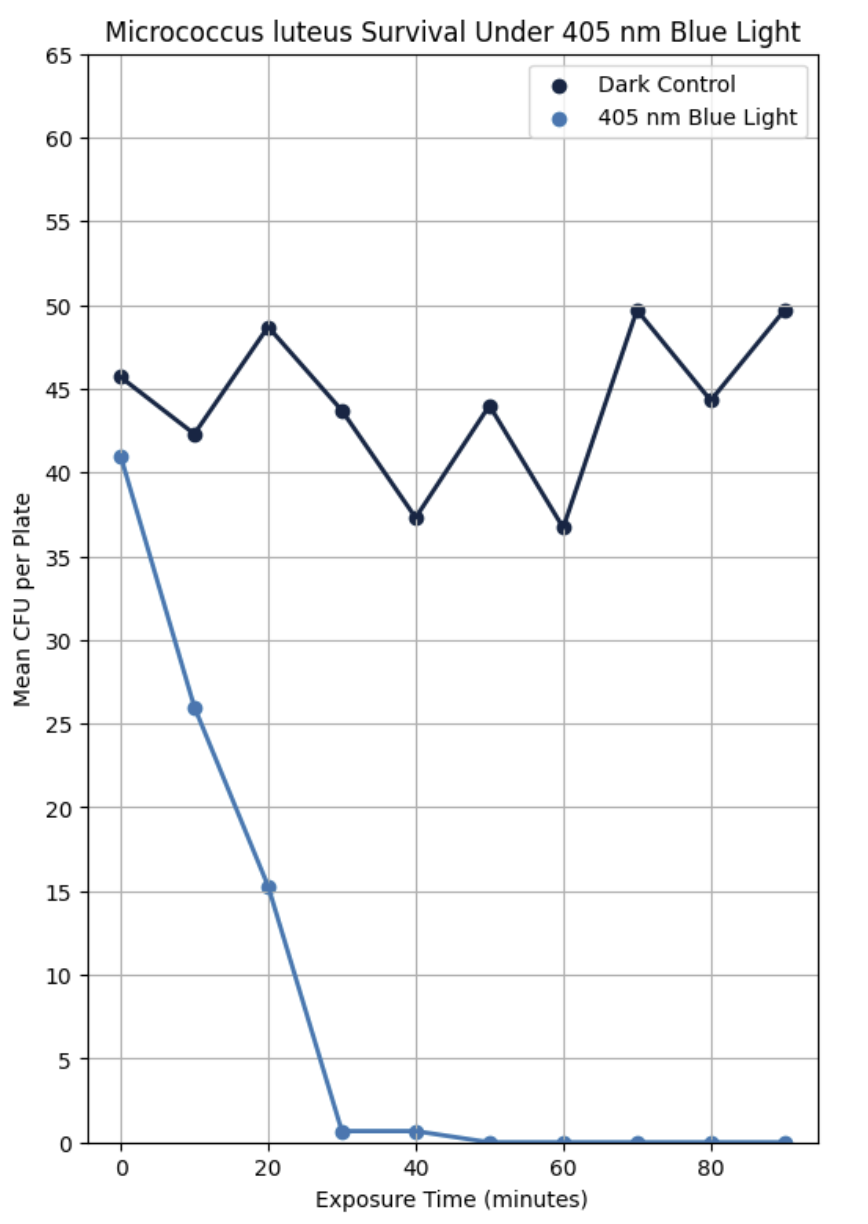
Kill curve — CFU vs. exposure time (light vs. dark controls).
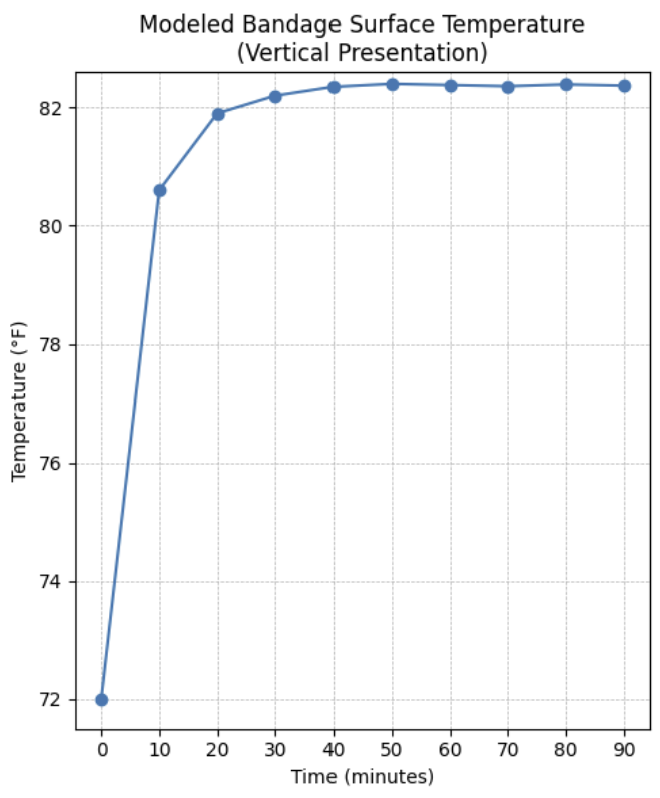
Thermal curve — wound-facing temperature over time (conservative run).
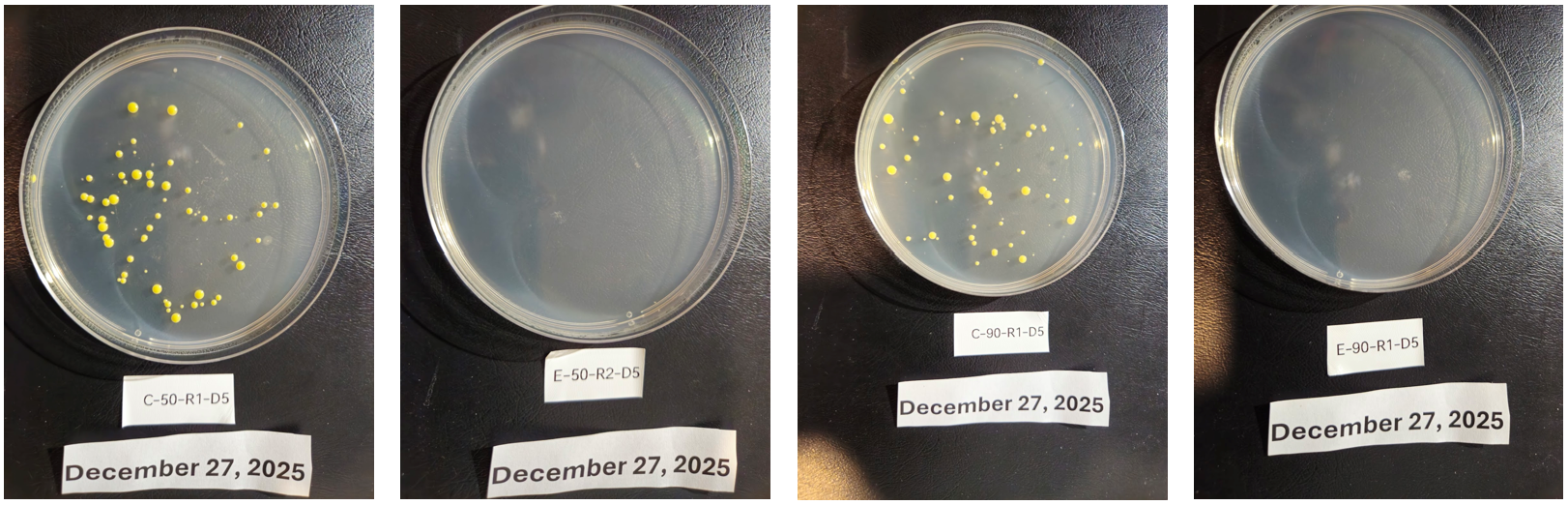
Representative plates — matched control vs. exposed examples.
Key themes from the literature (high level)
We keep this summary high-level on purpose. Typical themes in antimicrobial blue-light studies include:
Wavelength sensitivity
Microbial response depends on the spectral band, not just total brightness.
Dose-response behavior
Exposure time and irradiance interact; reporting both is critical.
Surface & geometry effects
Distance, scattering, and occlusion can change real dose at the target.
Selected literature supporting antimicrobial violet‑blue light (405–440 nm)
These papers and reviews inform our mechanism, safety framing, and conservative design targets. A full annotated bibliography is available upon request.
Impact of Blue Light Therapy on Wound Healing in Preclinical and Clinical Subjects: A Systematic Review.
Next: connect evidence to engineering
The Safety & Ethics page explains how we turn published photobiology into constrained design choices: exposure caps, thermal barriers, and predictable behavior.
Safety & Ethics